
Biomechanical Effects of Groton Chiropractic's Cox Technic
Cox Technic Flexion Distraction and Decompression offers conservative, non-surgical pain relief for spinal conditions not requiring surgery. Cox Technic enhances biomechanical changes to the spine, beneficial to pain relief.
Disc Related Spine Pain Conditions
Lumbar Spine
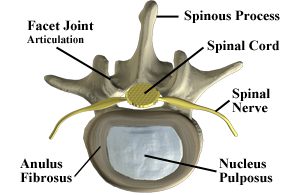
normal
Goal of Cox Technic for Lumbar Spine Pain Relief
The disc is pressing on the nerve. Note that as the disc herniation reduces, the pinched nerve is relieved.
This is an animation of the goal of Cox Technic Flexion-Distraction and Decompression: reduced irritation of spinal elements enough to relieve pain and help you regain your quality of life. The amount of decrease in size of the herniated disc necessary for pain relief varies from 0% to 100% for each individual patient.
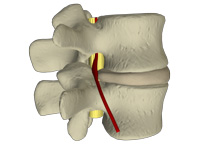
pain
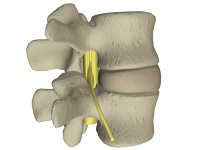
no pain
Cervical Spine
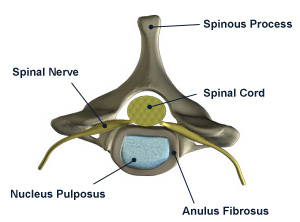
normal
Goal of Cox Technic for Cervical Spine Pain Relief
The disc is pressing on the nerve. Note that as the disc herniation reduces, the pinched nerve is relieved.
This is an animation of the goal of Cox Technic Flexion-Distraction and Decompression: reduced irritation of spinal elements enough to relieve pain and help you regain your quality of life. The amount of decrease in size of the herniated disc necessary for pain relief varies from 0% to 100% for each individual patient.
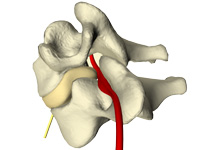
pain
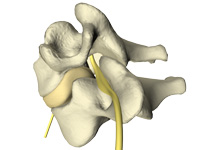
no pain
For patients with a "slipped/bulging/ruptured/herniated" disc (without cauda equina syndrome or progressive neurological deficit), Cox Technic supplies the following benefits:
- increases the intervertebral disc height (C) to remove anular tension on the anular fibers (E) and nerve (B) by making more room for, among other tissues, the spinal cord (F) and improving circulation;
- allows the nucleus pulposus (A) -- the center of the disc -- to assume its central position within the anular fibers (E) and relieves irritation of the spinal nerve (B);
- restores vertebral joints (D) to their physiological relationships of motion;
- improves posture and locomotion while relieving pain, improving body functions, and creating a state of well-being.
Non-Disc Related Spine Pain Conditions
For patients with other conditions causing back pain (facet syndrome, spondylolisthesis, sprain/strain, scoliosis, transitional vertebra, sacroiliac subluxation, stenosis), Cox Technic provides all of the above benefits plus the ability to place the spinal joints into normal, painless movements so as to restore spinal motion without pain.
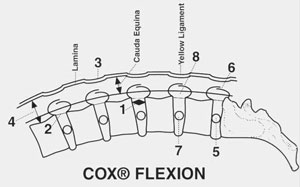
The disc is pressing on the nerve. Note that as the disc herniation reduces, the pinched nerve is relieved.
- The posterior disc space increases in height.
- Flexion decreases disc protrusion and reduces stenosis.
- Note: Discs protrude and degenerate into the concavity of a curve, into the side of extension.
- Flexion stretches the ligamentum flavum to reduce stenosis.
- Flexion opens the vertebral canal by 2 mm (16%) or 3.5 to 6 mm more than extension.
- Flexion increases metabolite transport into the disc.
- Flexion opens the apophyseal joints and reduces posterior disc stress.
- Intradiscal pressure drops under distraction decompression to below 100 mm Hg. On extension, the nucleus or anulus is seen to protrude posteriorly into the vertebral canal.
- Intervertebral foraminal openings enlarge giving patency and increased space for the nerve.
Reference
- Cox JM, Feller JA, Cox-Cid JA: Topics in Clinical Chiropractic 1996; 3(3):45-59